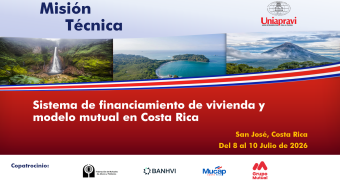
Housing Finance System and Mutual Model
The Inter-American Housing Union (Uniapravi), together with the Costa Rican Federation of Savings and Loan Associations, the National Housing Mortgage Bank (BANHVI), Mutual Cartago, and Grupo Mutual de Costa Rica, successfully organized the Technical Mission "Housing Finance System and Mutual Model in Costa Rica," from July 8 to 10, 2026.
The Mission provided an in-depth look at Costa Rica's experience in housing policy and urban development, highlighting the National Housing Finance System (SFNV) as one of the most established models in Latin America for facilitating access to housing. The Mission analyzed the foundations of the law that created the system, its objectives, and the coordination among public institutions, financial entities, and sector organizations to address the housing needs of different segments of the population. A key aspect was the operation of the Family Housing Bonus as a demand-side subsidy instrument, as well as its evolution toward more flexible modalities, such as the deferred bonus, the bonus for a second story, and the community bonus, which allow for responding to diverse social and territorial realities. The Savings, Bonus, and Credit (ABC) model was also presented as a comprehensive mechanism that combines subsidies, prior savings, and mortgage financing to expand access to housing solutions.
During the presentations, the role of the National Housing Fund as a second-tier entity responsible for channeling resources to authorized entities for short- and long-term loans was also addressed. These loans are intended for both home purchases and the financing of housing projects through bridge loans and fiduciary guarantee schemes. The participation of the Housing Savings and Loan Associations was highlighted, whose track record has contributed to the development of the Costa Rican mortgage market through specialized products for social housing, sustainable housing, and other population segments. The presentations highlighted the importance of financial sustainability, corporate governance, product innovation, and digital transformation as fundamental elements for strengthening the competitiveness of these entities and responding to the new challenges of the financial and housing systems.
Finally, the Mission provided an opportunity to learn about initiatives focused on sustainable urban development, including the Inclusive and Sustainable Urban Housing (VUIS) model, which promotes projects with better urban integration, access to services, and environmental sustainability criteria. Technical visits to the Jacaranda, Almendares, and Ecopotrerillo housing projects in San Rafael de Heredia complemented the theoretical sessions by demonstrating the practical application of financing, subsidy, and urban planning instruments. These experiences showed how coordination among the government, financial institutions, developers, and trade associations has allowed for the consolidation of a housing model that combines social inclusion, sustainability, financial stability, and innovation, offering important lessons for other countries in the region interested in strengthening their housing finance systems.
Our institutional thanks to the Costa Rican Federation of Savings and Loan Mutuals, Banco Hipotecario de la Vivienda-BANHVI, Mutual Cartago and Grupo Mutual de Costa Rica, for hosting the foreign delegates and sharing their experiences.